
The Ortho Edit · Edition 01
Invisalign Specifix: printed attachments, simpler visits.
Invisalign's new Specifix system 3D prints the small tooth-coloured bumps that help aligners grip. What is new, why it matters, and what Dr Amna is looking forward to.
What's new
Most people who have Invisalign (clear aligner treatment) will have attachments: small, tooth-coloured bumps bonded to some teeth so the aligner has something to hold on to. They help aligners rotate, tilt and move teeth the way the digital plan intends.
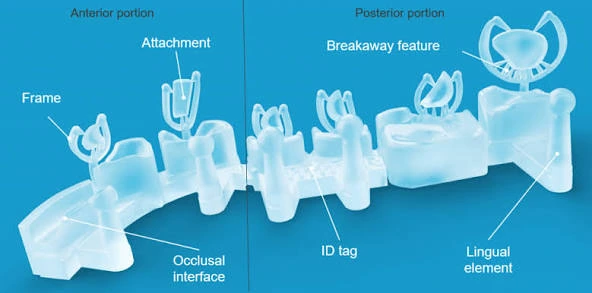
Align Technology, the maker of Invisalign, has introduced the Invisalign Specifix Attachment System. The attachments are 3D printed in a light-hardening resin (a photo-polymerized resin) to the shape, size and position set in the patient's ClinCheck plan, and they come ready to bond in small holders called positioners. The US Food and Drug Administration cleared the system on 9 October 20251, and Align previewed it at the 2026 American Association of Orthodontists meeting2.
Early clinical reports describe attachments that are smooth, comfortable and colour-matched to the teeth, with fewer instruments and less clean-up at the chair, and removal with dedicated angled pliers3. These first reports are individual cases, and more experience will follow as the system is used in everyday practice.
1
Planned digitally
The attachment's shape, size and position are set in the ClinCheck plan (Invisalign's 3D treatment plan).
2
Printed and ready
The attachments are 3D printed and arrive in a positioner (a small holder that carries them to the teeth).
3
Bonded to the tooth
They are bonded in the planned places, and the aligner clips over them to guide the teeth.
Why attachments matter
An aligner moves a tooth by pressing on it. On some teeth, a smooth surface gives the aligner little to grip, so a small attachment is added to give it a firm edge to push against. Once the treatment is finished, the attachments are removed and the teeth are polished.
My clinical perspective
What I find particularly exciting about Specifix is the potential to make the attachment process simpler, cleaner, and more comfortable for patients.
With less excess material to clean around the attachments and the possibility of removing them with dedicated pliers, rather than having to remove bonded composite from the enamel using rotary instruments, this could make a real difference to the patient experience, particularly during attachment removal.
From a clinical perspective, I’m looking forward to seeing how this technology performs in everyday practice, especially its impact on chairside time, attachment debonding rates, and overall clinical efficiency.
If it delivers consistent attachment precision while simplifying both placement and removal, Specifix could be a very welcome advancement in clear aligner treatment.
What this means for you
If you are starting Invisalign, attachments are a normal part of treatment, and they are removed and polished away at the end. If you would like to know how your attachments will be planned and placed, ask at your assessment. Availability of new systems varies by country and by clinic.
General information, not personal medical advice. Every mouth is different; book an assessment to talk about yours.
Sources
- US FDA 510(k) premarket notification K252870, Invisalign Specifix Attachment System, Align Technology, Inc. Decision: cleared, 9 October 2025. accessdata.fda.gov
- Orthodontic Products. Align Technology previews Invisalign innovations at AAO 2026. 1 May 2026. orthodonticproductsonline.com
- LaVacca MI. The impact of Invisalign Specifix attachment system on orthodontic outcomes and practice efficiency. Orthodontic Products. 14 August 2026. orthodonticproductsonline.com
Keep reading